

Bugonia was recently released in theaters, marking the fourth collaboration between Yorgos Lanthimos and Emma Stone. Through this partnership, we can see an intimate relationship and understanding forming project by project, and how that translates on screen; from the way Lanthimos’s camera captures Stone’s electrifying performances to the way she embodies his characters and helps deliver the magic of his vision.
Of course, this is not a unique phenomenon. The history of cinema is filled with director–actor collaborations that have had a profound impact on shaping the art form. When directors and actors continue to work together across multiple projects, audiences can feel the chemistry, the trust, and the evolving relationship that develops both on and off the screen. These partnerships often circle the same themes, genres, or obsessions, creating a body of work that feels like an ongoing conversation.
What’s remarkable is how these collaborations benefit both sides: the director finds a performer who can channel their vision with precision, and the actor finds a filmmaker who can push them to new heights. But ultimately, the ones who benefit the most are cinema itself, and of course us, the audience, who get to witness the results.
Here are seven of the most significant director–actor collaborations in film history, and how they shaped careers, genres, and the very language of cinema.
Martin Scorsese & Robert De Niro
Few collaborations in cinema history carry the weight and influence of Martin Scorsese and Robert De Niro. Over the course of ten films, beginning with Mean Streets (1973) and extending to Killers of the Flower Moon (2023), their partnership has produced some of the most iconic works in modern film. Together, they didn’t just contribute to the gangster genre; they reshaped it, turning it into a vehicle for exploring morality, violence, guilt, and redemption.
What makes this collaboration so inspiring is not only the intimate creative chemistry visible on screen, but also the personal bond that sustained it off screen. At moments when Scorsese was struggling, it was De Niro who brought him projects – most famously Raging Bull – that reignited his career and pushed him to new artistic heights.
The results speak for themselves: Taxi Driver, Raging Bull, Goodfellas, Casino, The Irishman, and Killers of the Flower Moon are not just milestones in their careers, but cornerstones of American cinema. This collaboration is more than a series of films; it’s a 50-year conversation between two artists who continually challenge and elevate each other.

Akira Kurosawa & Toshiro Mifune
Few collaborations in world cinema rival the scope and impact of Akira Kurosawa and Toshiro Mifune. Over 16 films in 17 years, beginning with Drunken Angel (1948) and ending with Red Beard (1965), they forged a partnership that defined Japanese cinema and influenced filmmakers across the globe.
Kurosawa found in Mifune an actor capable of embodying the morally complex, often tormented characters at the heart of his stories. Mifune, in turn, found a director who pushed him relentlessly, shaping performances that remain among the most powerful in film history.
Together, they delivered masterpieces that changed cinema forever: Rashomon (1950), which introduced Japanese film to the world stage; Seven Samurai (1954), a landmark in action and ensemble storytelling; Throne of Blood (1957), a haunting reimagining of Macbeth; and High and Low (1963), a gripping modern crime drama. Their collaboration was not without tension, but the body of work they left behind is monumental; an enduring cinematic language of human struggle, honor, and ambiguity.

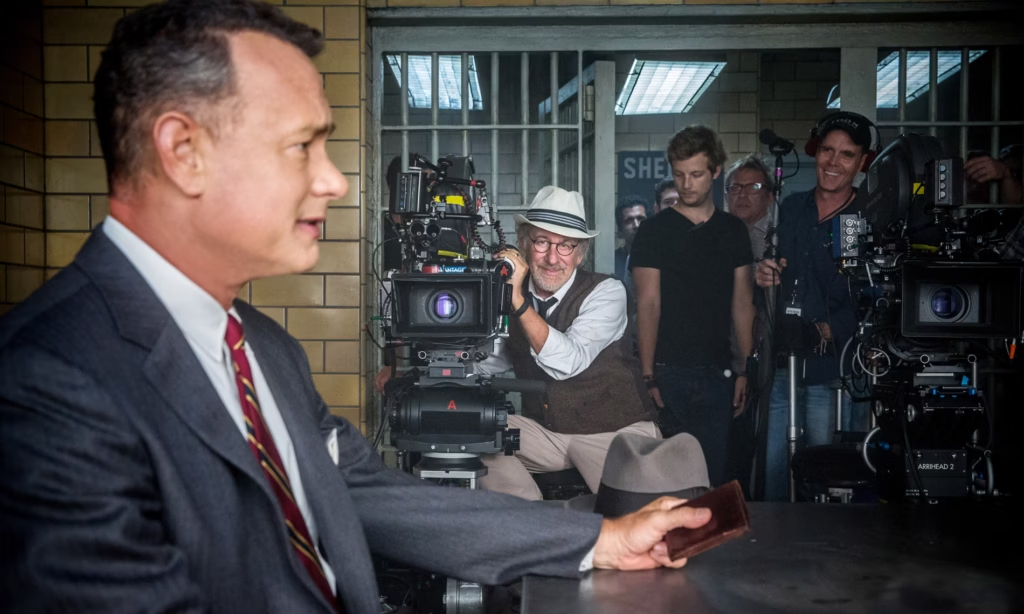
Steven Spielberg & Tom Hanks
Steven Spielberg is famous for his long-standing creative partnerships with John Williams for music, Michael Kahn for editing, and a circle of trusted producers and screenwriters. But when it comes to actors, no collaboration has been as enduring or impactful as his work with Tom Hanks.
Across five films from Saving Private Ryan (1998) to The Post (2017), Spielberg and Hanks have built a body of work that spans genres and tones.
What makes this partnership remarkable is its range. On one end, they’ve given us lighthearted, playful films like Catch Me If You Can and The Terminal. On the other, they’ve tackled some of the most daunting and emotionally devastating projects in American cinema, most notably Saving Private Ryan.
Together, Spielberg and Hanks have created a shorthand built on trust and mutual respect. Spielberg finds in Hanks the perfect vessel for his vision of decency under pressure, while Hanks finds in Spielberg a director who can stretch his range from comedy to tragedy without losing his essential humanity.
Pedro Almodóvar & Penélope Cruz
It’s difficult to describe the partnership between Pedro Almodóvar and Penélope Cruz as anything other than magical. Almodóvar has always been obsessed with blending heightened, almost fantastical elements with the rawness of real life, and at the center of his cinema is his fascination with women, especially mothers. In Cruz, he found not just a muse but a collaborator who could embody those obsessions with extraordinary depth and nuance.
Their collaboration spans seven films, from Live Flesh (1997) to Parallel Mothers (2021). Across these works, Cruz has become the face of Almodóvar’s most intimate stories, often portraying women whose strength is inseparable from their vulnerability.
What makes this collaboration so powerful is the way Almodóvar’s camera seems to see Cruz differently. She has always been one of the most beautiful women in cinema, but through his lens, her beauty becomes doubled; infused with layers of fragility, resilience, and emotional truth. Together, they’ve created a body of work that feels like an ongoing dialogue about identity, memory, and the complexity of womanhood.

Paul Thomas Anderson & Philip Seymour Hoffman
The creative relationship between Paul Thomas Anderson and Philip Seymour Hoffman is one of the most poignant in recent film history. Across five films from Hard Eight (1996) to The Master (2012), Anderson continually found new ways to challenge Hoffman, and Hoffman, in turn, gave Anderson some of his most unforgettable characters.
What makes this collaboration so striking is its evolution. Hoffman began with small supporting roles in Hard Eight and Boogie Nights, yet even in limited screen time he left a lasting impression. By Magnolia, he was anchoring the film with quiet compassion, and in Punch-Drunk Love he distilled menace into just a few minutes of screen time.
Their partnership reached its peak with The Master, where Hoffman finally took center stage as Lancaster Dodd, a performance that was magnetic, terrifying, and deeply sad. It remains one of the greatest achievements of his career. Together, Anderson and Hoffman created a gallery of characters who embody the contradictions of human nature: fragile yet forceful, broken yet commanding.

Ingmar Bergman & Liv Ullmann
The collaboration between Ingmar Bergman and Liv Ullmann is unlike any other, because it extended far beyond the professional realm into one of the most complex and intimate personal relationships in cinema history. They were partners in life as well as in art; living together, having a child, separating, and yet continuing to work together across ten films.
Bergman’s films are famously haunting, often grappling with themes of identity, mortality, faith, and despair. Ullmann carried them with extraordinary courage, from Persona (1966) to Saraband (2003).
Their relationship, their break, and their enduring bond all bled into the work. Ullmann herself has spoken about this with heartbreaking honesty in the documentary Liv & Ingmar (2012), which captures both the sweetness and the sadness of their connection. Together, they created films that continue to challenge, unsettle, and move audiences; a collaboration as complex and unforgettable as the art it produced.

Martin Scorsese & Leonardo DiCaprio
Leonardo DiCaprio has always been drawn to ambitious projects and visionary filmmakers, but no director has defined his career more than Martin Scorsese. From Gangs of New York (2002) to Killers of the Flower Moon (2023), they have worked together on six films. Over two decades, this partnership has become one of the most significant in modern cinema.
For Scorsese, DiCaprio became the natural successor to Robert De Niro: a performer capable of embodying the same intensity and moral ambiguity, but with a volatility and energy suited to the 21st century. Where De Niro often gave Scorsese’s films a brooding stillness, DiCaprio brought volatility; characters who unravel in front of us, consumed by obsession, greed, or paranoia.
Unlike some director–actor pairings that repeat a formula, Scorsese and DiCaprio keep finding new genres, tones, and characters to explore together. Their films span historical epics, crime dramas, psychological thrillers, and biting satires, yet all are bound by a shared fascination with flawed men caught in systems larger than themselves.

Conclusion
From Scorsese and De Niro’s half‑century dialogue to Lanthimos and Stone’s still‑unfolding story, these collaborations remind us that cinema is never just about a single performance or a single vision. It’s about the trust, chemistry, and shared obsessions that grow when two artists return to each other again and again, shaping not only their own careers but the history of film itself.
These seven pairings are only a glimpse of what’s possible when director and actor move in sync. Now I’d love to hear from you: which director–actor collaboration has left the deepest mark on you as a film lover?


